
One thing I love about teaching is the learning. You never truly know something until you can teach it, and while you’re teaching you often learn more than your student! At least I find it that way.
Recently I came across a “new” way to perform “long division.” It’s called division by partial quotients. It’s been gaining popularity in the UK and US since the 1990’s but it’s really not that new at all. It is actually very similar to an algorithm invented by the Ancient Egyptians and used extensively until Hindu Arabic numerals (the numbers we use today) made the more efficient “standard” long division algorithm possible.
The thing I like about division by partial quotients is that it actually reveals what division is all about, which is: “how many times can I take the divisor away from the dividend?” Not only that, but it makes the process easier because it is much more flexible. Unlike the standard algorithm, with partial quotients there is more than one way (actually a potentially infinite number of ways) to get to the final answer.
So, let’s see how this works. Let’s say we want to divide 792 by 9. We set up the division in a very similar way to long division:
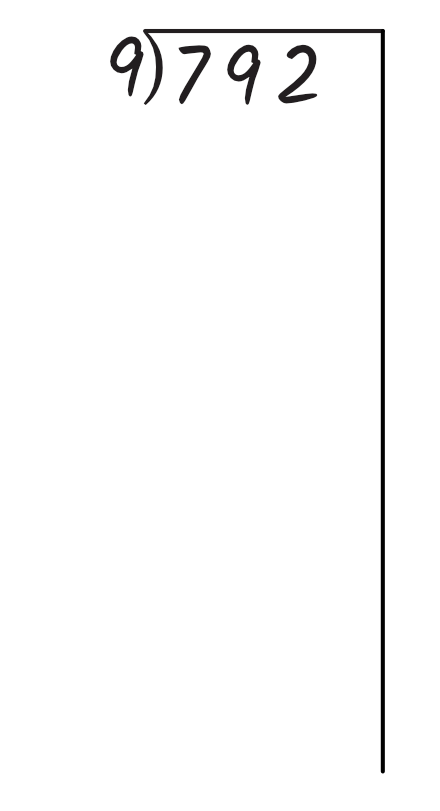
Now, we think, “How many times can I subtract nine from 792?” The good thing about this algorithm is that it doesn’t matter if you actually don’t pick the absolute biggest number. It will still work! So, let’s say I think, “Well, I know that six nines is 54, so sixty nines will be 540.” We could get higher but we can also just start with this. We subtract the 540 from 792, and keep a record of the 60 on the side (so we know how many nines we eventually subtract) like this:
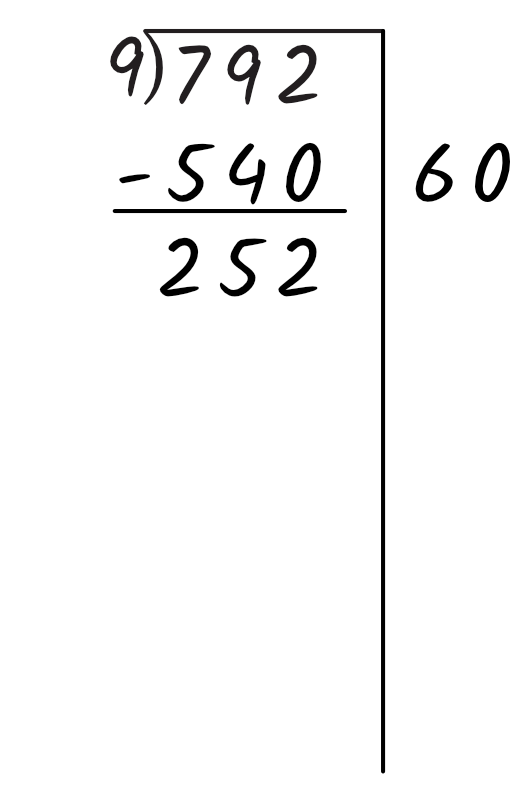
OK, so now we have 252 left. Again we ask ourselves, “What is the biggest number of nines I can subtract from 252 without going over?”
“Well, I know that three times nine is 27, so thirty times nine will be 270.” Nope, no good. “OK, 20 times 9 is 180!”
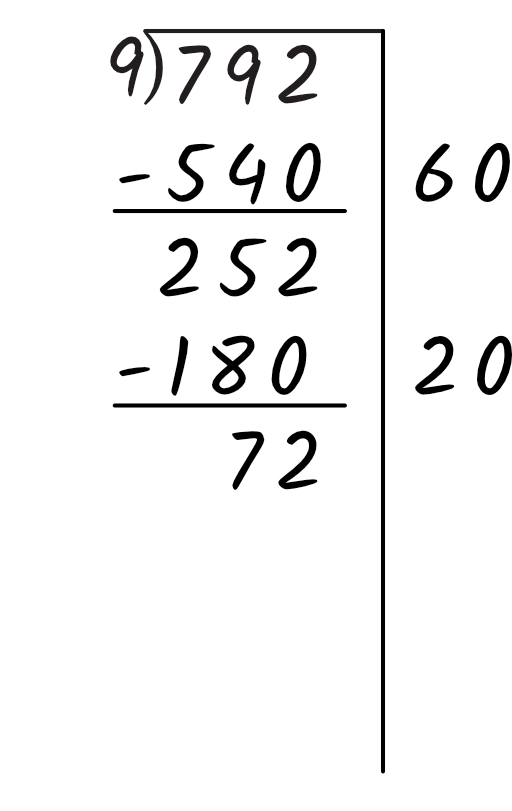
Now, we’re left with only 72. By the time I’m introducing long division to kids, I hope they know their nine times tables pretty well! If not, you COULD let them look it up on their chart. But I’d almost have them keep subtracting for the practice.
Anyway, I know that 8 times 9 is 72, so we have:
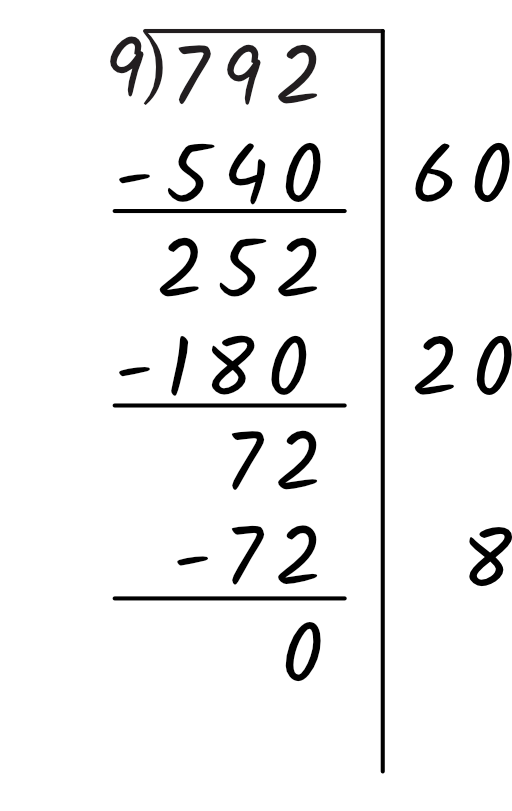
To find the final answer, we just add up the number of times we subtracted nine. That’s the numbers we’ve been writing on the right hand side, by the way!
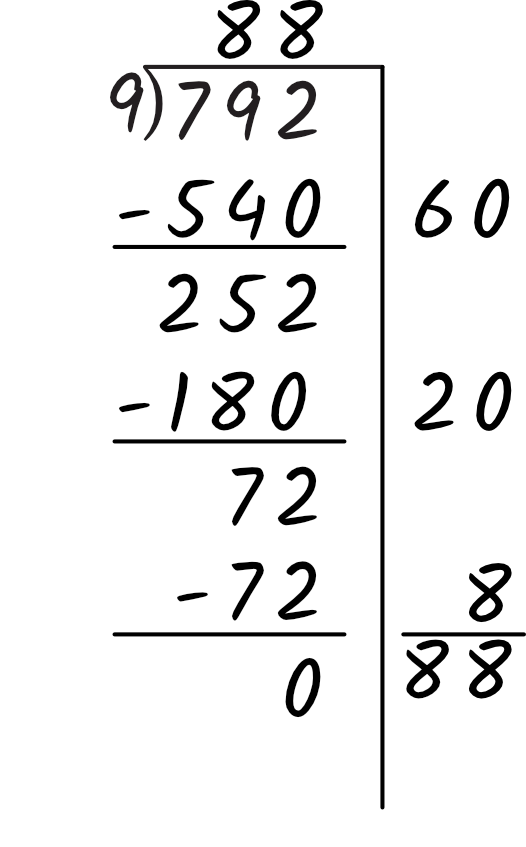
And that’s all there is to it!
One interesting little fact is that this algorithm is much closer to how a computer does division than the standard algorithm. If you really wanted to take this algorithm to its natural limit, you could subtract one nine at a time. But that would take a very long time and lots of paper 🙂
This is an example of the approach we take in Milestone Maths. We never teach an algorithm for its own sake but we also never expect a child to have understanding beyond their years. We teach efficient strategies that reduce cognitive load, rather than increasing it and we explain the why before we look at the how in every case. Take a look at our shop today to see if Milestone can help you make sense of maths in your homeschool.